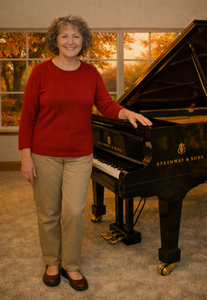
I have been a piano teacher and performer for more than five decades. I began playing the piano on my own at the age of three while waiting to take formal piano lessons at the age of seven. Almost immediately, I started passing on my enthusiasm to friends and family by giving them free piano lessons – whether they wanted them, or not!
While still in high school, I started taking college courses at a nearby music conservatory. After high school, I received a scholarship at that conservatory to continue my music studies. I double-majored in piano and voice and earned a Bachelor of Music degree.
After conservatory training, I taught music in the public schools and performed in a band with my husband, who is a bassist and saxophonist.
Graduate School – Master’s Thesis and Doctoral Dissertation
After a few years of public school teaching, I returned to music school to pursue graduate studies. While working on my Masters and Doctorate degrees, I taught piano to undergraduates. My Master’s Thesis included a full Master’s Recital.
In order to earn my Doctoral Degree, I was required to independently research, write, and defend an original contribution to piano pedagogy (piano teaching) before a cross-discipline faculty committee. I had a fascination with the new concept of people being labeled as right-brained and left-brained individuals. My experience personally studying and performing as well as in teaching made me question the current belief that music was a right-brained function. Through fMRIs, my dissertation study showed that when presented with new music concepts, both sides of our brains are in use simultaneously. My end game in this mission was to learn how I could teach most effectively if the difference is not brain hemisphere, but preferred ways of learning – visual, auditory, reading/writing, and/or kinesthetic. The results of my study suggested that music educators could better communicate music concepts to their students by using a variety of teaching methods and materials that include the students’ preferred learning styles.
Since the publication of my doctoral thesis, publishers of piano teaching materials have introduced a variety of method books designed to include different kinds of student learning styles. Today, skilled piano teachers use a wider variety of methods and materials in their teaching studios.
Application to My Teaching Practice
Since earning my doctoral degree, I continue to expand my knowledge of efficient and effective strategies that I use daily to communicate concepts of music to my students so they are able to reach their individual goals. I continuously review how a student grasps concepts and adjust my approach and materials until they understand the concepts completely. I believe this approach results in faster learning and a more enjoyable piano experience.
Law School
In addition to my background as a piano teacher, I have work and educational experience outside of the arts which has sharpened my critical thinking and made me a better communicator. A few years after earning my Ph.D. degree, I attended law school, where I graduated with honors. I passed the bar examinations in Ohio and Arizona. My first job after law school was clerking for a local judge, where I learned a great deal about how disputes are settled in a nation of laws. After several years, I practiced corporate law at a big city law firm followed by my own solo estate planning and probate practice. I no longer practice law, preferring instead to concentrate on my passion for teaching others to enjoy playing the piano.